Memory Field
Some memories are like magnetic fields.... others are like meadows...

“Memory Field” is the title track for the new album I’ve been writing about—it is for string quartet alone, in scordatura, composed for the Bergamot Quartet:
“Memory Field”—track 4 from the album Memory Field
- Performed by the Bergamot Quartet
- Composed by Dan Trueman
- Recorded, Mixed, and Mastered by Matt Poirier
My program notes for this piece:
Some memories are like magnetic fields that invisibly draw you to them, relentlessly. Others are like meadows that you can wander through, without direction or purpose, year after year. Imperfect repetitions, transforming, broken, discontinuous, vanishing. As Mark Twain tells us, “memory is a curious machine and strangely capricious. It has no order, it has no system, it has no notion of values, it is always throwing away gold and hoarding rubbish.” I remember a curmudgeonly fiddler insisting that the only tunes worth playing are the ones you can remember. So wrong.
Ironically, I can’t remember how I converged on the scordatura for this piece:
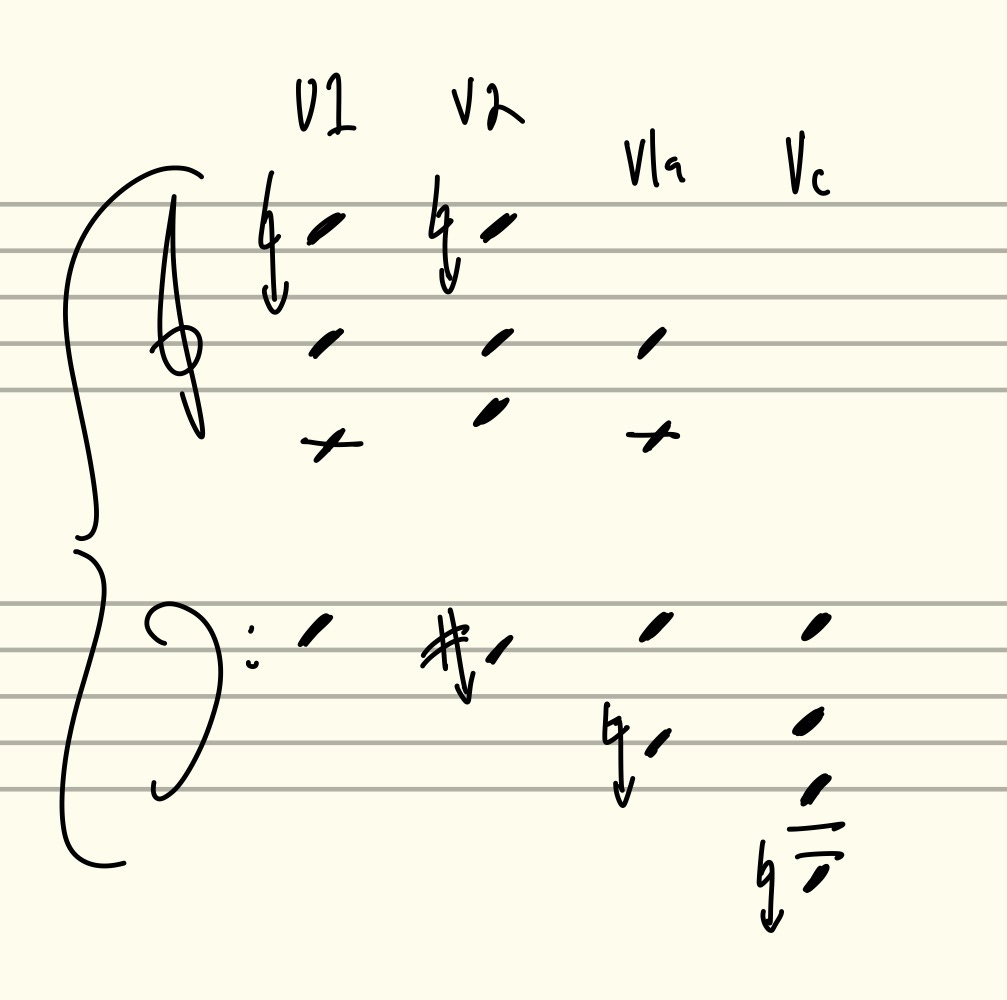
In some ways, it is pretty extreme, leaving the group with only one common pitch among all the instruments (G). But in other ways, it is mild, with no string tuned more than a whole-step away from its standard pitch.
For the tuning nerds out there: I’m a pretty happy guy in a 5-limit field, and find all sorts of fascinating things in the cracks that just-tuned 3rds and 6ths reveal. For instance, this phrase from “Memory Field”…
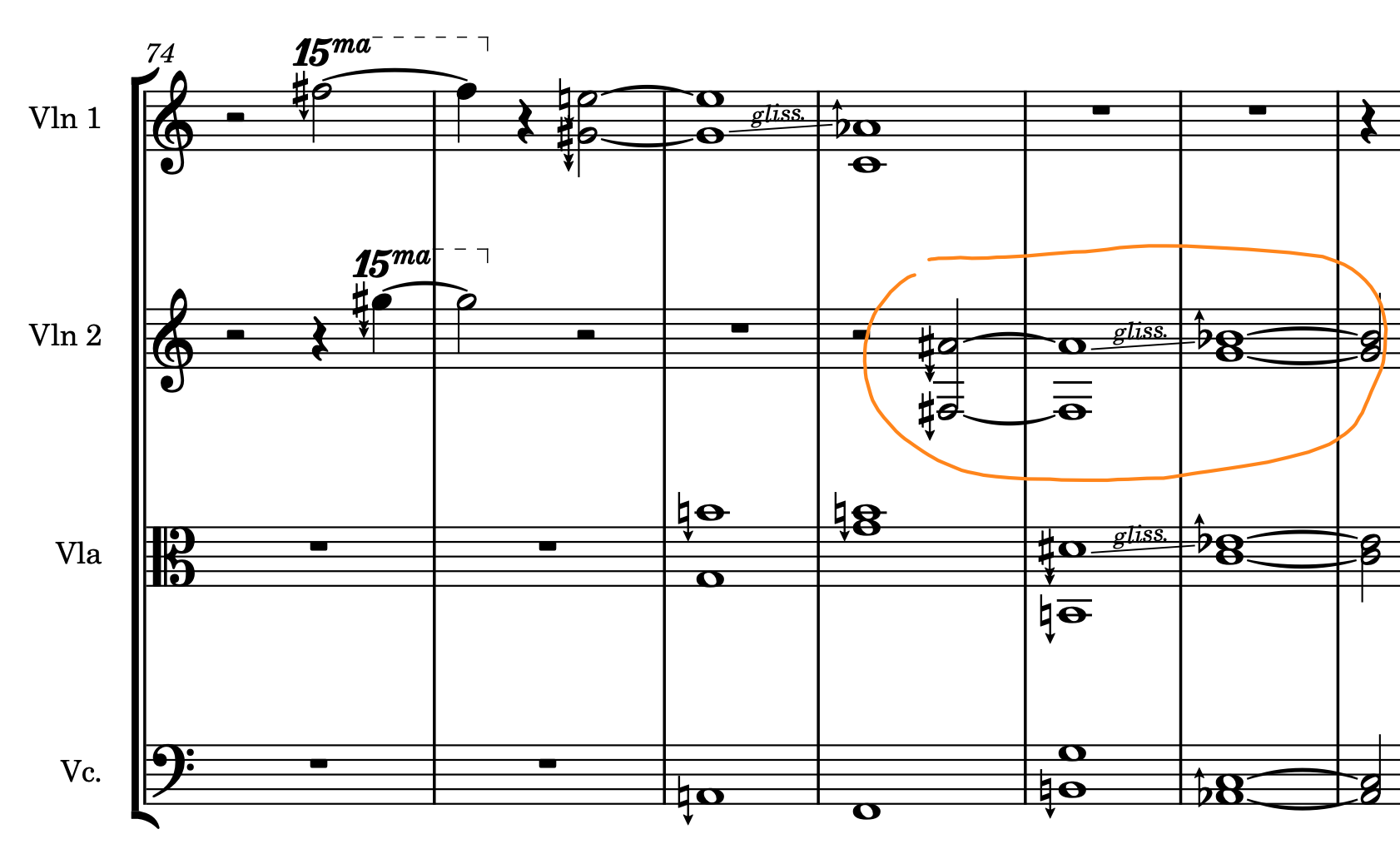
… yields voice-leading that reminds me of a cross-relation but technically is super different. While in a conventional cross-relation a pitch is immediately followed by a chromatic alteration of itself in a different voice (and sometimes the original and its chromatic alteration overlap, as in the occasionally-gruesome-but-usually-delightful English cadence), here the third of a chord is transformed by a change in bass underneath (which is reminiscent of harmonic motion by 3rd, where, for instance, a C-major chord followed by an A-major chord will force a change of C to C#). In mm. 77-79 in the excerpt above, the second violin’s A#, which is a just-tuned major 10th over the open F# (itself already “low” because it is just-tuned against the open D in the scordatura, as indicated by the down-arrow in the accidental), is some 25 cents low to equal-temperament, but when the bass changes to the open G, the A# becomes a Bb, a just-tuned minor 3rd to the open G and about 16 cents sharp to equal-temperament:
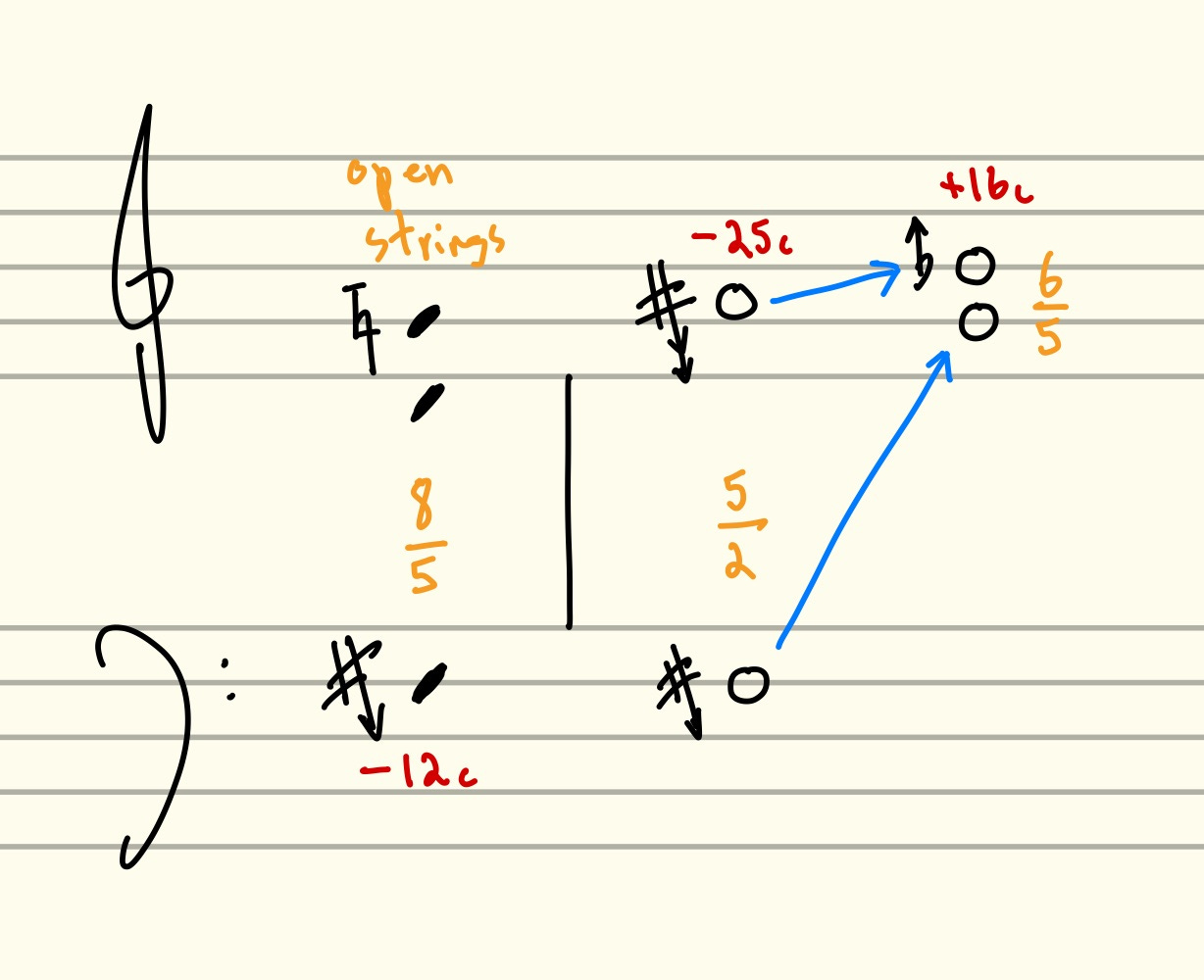
So the shift of bass from F# to G (both open strings) warps the A#/Bb by almost a quarter-tone—so much for a common-tone! In practice, the violinist just slightly rolls the finger up to make this move happen; no sliding here. Similar moves happen in the violin 1 part just before, and viola just after. I confess I love this little warped chorale section! And it’s a bit disorienting. If you want to explore more, here are the score and parts.
The full Memory Field album will drop in about two weeks, when I’ll write about the final tracks, a 3-movement quartet in an entirely different scordatura.